Product-market fit is not built. It is found.
Found one failed experiment at a time. Descobri turns your idea into your first tests: each with a number that says keep going or stop, and the right people to run it with.
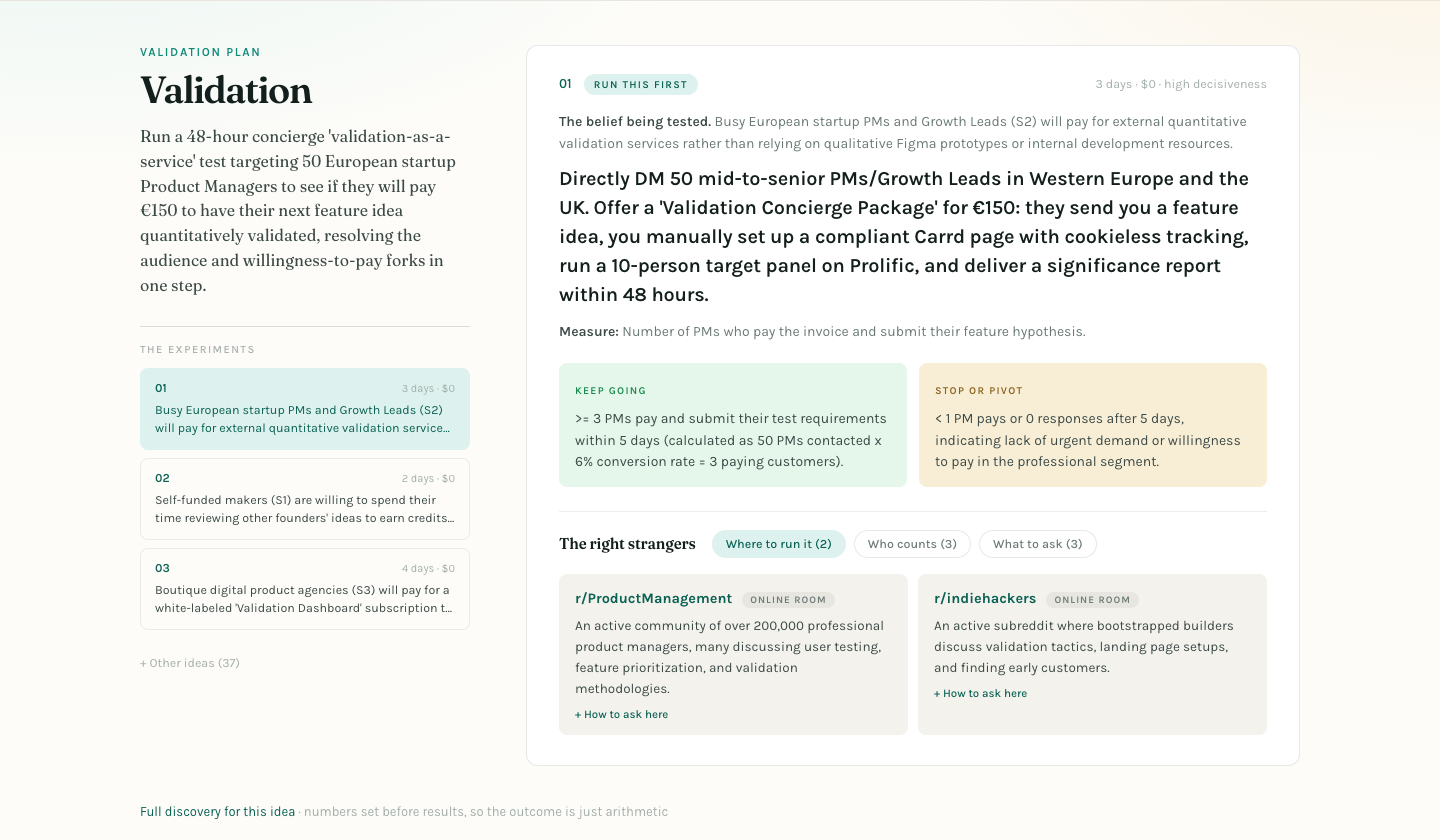
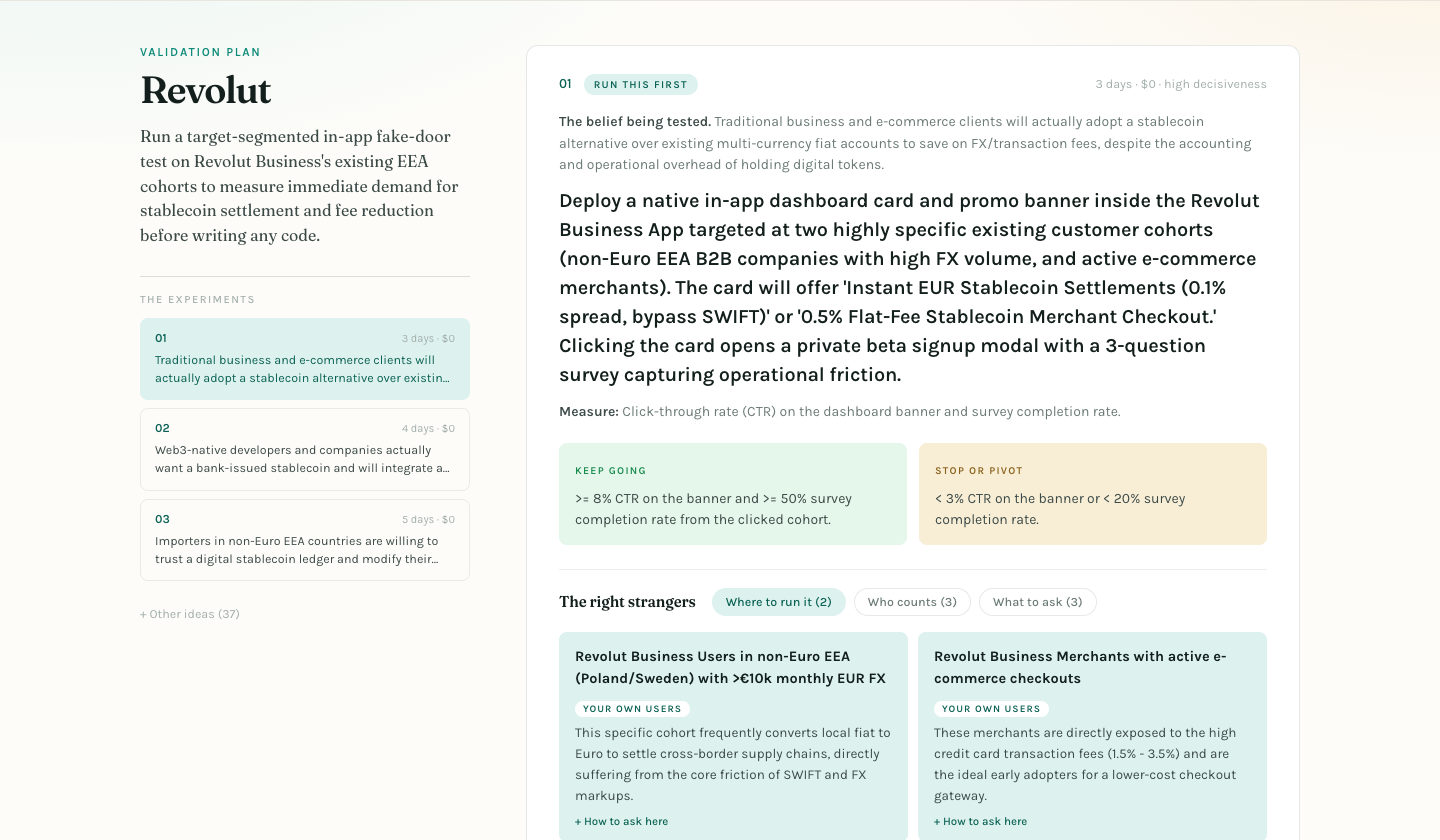
For a new ideaA real plan, as it arrives: the experiment to run first, the number decided in advance, and the right strangers to run it with.
Three steps, then a decision.
- Describe your idea. The more you tell it, the sharper the tests. Then answer a series of questions about what matters.
- Run discovery. It researches your idea and designs the tests, usually in under ten minutes.
- You arrive at your first tests. A few small experiments, each with a keep going or stop number decided in advance, and the right people to run them with.
Describe your idea
The more you describe, the sharper the tests.
Three questions worth answering first.
Is there a real reason your idea should exist?
Not "the market is big". Something specific: a rule changed, a cost dropped, a group nobody serves well. We list the real reasons and flag the ones that are only wishful.
Who exactly has this problem, and where do they gather?
Not "small business owners". Specific people you could count and reach: the communities, groups and places they already go to, online and offline, and what to ask them once you are there.
What is the smallest version they would actually use?
Not the full product. One piece, small enough to show them before you build anything, and enough to learn whether they want it.
You already asked the wrong people.
Analysis is close to commodity. Recruiting is the bottleneck. The first feedback is always free, and it never comes from the right people.
The fastest route there runs through the failures.
Nobody lands product-market fit on the first guess. The founders who get there got through the most wrong guesses cheaply. What AI changes is the price of one loop: a small test, aimed at the exact people who feel the problem. Fail the wrong versions fast, and what is left standing is worth building.
The questions people actually ask before they start.
How do I know if my idea is worth building?
You cannot know in advance. Name the one belief that would sink it, test it as cheaply as possible, and write down the number that would change your mind before you see the result.
How do I validate an idea without building it?
The smallest artifact that produces a real reaction: a fake door, a concierge version run by hand, a pre sell at a real price, twenty direct messages to named people. Opinions are weakest, time is better, money is strongest.
What if it tells me to stop?
Then it did the expensive part for free. A red flag on a two day, zero dollar test is a year handed back. This one is built so that it can say no.
Where do I actually find people to validate with?
Not your circle. Each plan names the communities your buyers already gather in, links checked, rules noted, offline rooms when your idea lives offline, and a screener so the wrong five people do not count.
How long does it take, and what does it cost?
Usually under ten minutes, though a busy model provider can stretch that. Free while pricing is worked out: one idea per account, no card, no password.
Do you use or share my idea?
No. A private workspace, never sold, published or used to train anything. Your idea is not the product here. The feedback is.
Go after the idea. Just ask the right people first.
Bring the idea you keep coming back to. Ten minutes from describing it to reading your plan.
Free while in early access, one idea per account. No card, no password to create, and your ideas stay yours.